

Show notes
Episode 101 · November 25, 2026 · 1:03:35
Listen & Watch: YouTube · Spotify · Apple Podcasts
Chapter TimestampsEpisode SponsorsArticlesFree Tools & WorksheetsThings We LikeAll Episodes
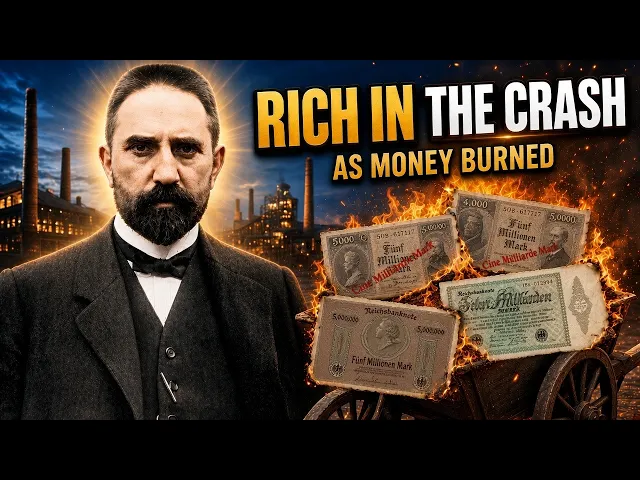
$1 = 4.2 Trillion Marks: How Hugo Stinnes Got Rich as Weimar Fell
Germany, 1923. One US dollar buys 4.2 trillion marks, and people burn banknotes for heat because it's cheaper than firewood. Hugo Stinnes borrows every collapsing mark the banks will give him and buys factories, mines, hotels and newspapers. When the currency dies, his debts die with it, and he becomes the richest man in Germany.
The chaos is real. The question Randy asks in Episode 101 of Tales of Abundance is whether you have the right strategy to deal with it.
Anthony Marino has lived through a lot of it: the misery index of the late '70s, duck-and-cover drills during the Cuban Missile Crisis, the oil embargo, the 1987 crash and COVID. Randy Lorensen lists what's going on now, from the wars and a market selloff to the FBI hacks and Jensen Huang being out at NVIDIA, and wonders out loud whether someone wants us scared. Anthony pushes back on the headlines, then uses the Bolshevik Revolution and East vs. West Germany to show what works. Randy points to Greece, which went broke ten years ago and came back.
Then they get practical. Randy's protection plan is hard assets: gold back then, Bitcoin now (he's betting big). He tells the story of a Venezuelan Bitcoiner who borrowed at over 100% interest to short his own currency. That's high risk and not financial advice. AI fixed a printer Randy had fought with for six years in a couple of minutes, and Anthony says it's the best time to be alive to start a business. They wrap on what you control: time with family and friends, a flight to Ohio with the granddaughters, and turning off the negative news.
Then, in the Abundance Briefing, an AI-assisted proof of the 167-year-old Riemann hypothesis, a study of 79,000 students that ranks time with other people as the top predictor of flourishing, CRISPR rice that fights bacterial blight, a new finger millet variety that could let Zimbabwean smallholders harvest 10x more, solar panels over wheat fields, water-based batteries, and a gene therapy that nearly erased seizures in drug-resistant epilepsy.
Read the companion article: How to Thrive in Chaos: Hugo Stinnes and Hard Assets
Timestamps
- [00:00] Hugo Stinnes gets rich in Weimar Germany, 1923
- [02:02] Anthony's worst: the misery index of the late '70s
- [03:06] Duck-and-cover drills and the Cuban Missile Crisis
- [08:34] COVID and the fear that came with it
- [12:38] Kent State and a Vietnam-era parallel
- [14:40] What's going on now: wars, markets, hacks, NVIDIA
- [16:15] Most headlines aren't as bad as they're reported
- [19:44] Devil's advocate: does the news firehose make it worse?
- [22:10] Randy's theory: is someone trying to scare us?
- [24:14] So what's the solution? The Bolshevik Revolution
- [28:39] Greece went broke and came back
- [30:29] East vs. West Germany: freedom vs. top-down control
- [33:19] $41 trillion in debt and Social Security
- [34:06] How to protect yourself: gold, Bitcoin, hard assets
- [34:58] Doing a Hugo Stinnes (high risk, not financial advice)
- [36:29] Never a better time to be alive: AI and business
- [38:40] Friends, family and fun
- [39:33] A flight to Ohio with the granddaughters
- [40:27] Turn off the negative news
- [41:49] History leaves clues: the real assets stay
- [43:24] Sponsor: micro1
- [45:19] Abundance Briefing: AI-assisted Riemann hypothesis proof
- [49:00] Time with other people predicts flourishing
- [51:33] Abundance of food: CRISPR rice, millet, and solar over wheat
- [57:12] Water-based batteries
- [1:00:23] Gene therapy nearly erases epilepsy seizures
- [1:02:13] Outro
- [1:02:28] Sponsor: AG1 (shop.drinkag1.com/tales — through 1:03:35)
SPONSORED BY micro1 -- $100K-$2M+ AI Operational Data Partnerships & Vetted AI Talent
The next generation of AI needs to learn how real companies operate day to day. Through https://talesofabundance.com/micro1 (/micro1/), U.S. and allied AI labs are paying qualifying established companies (30+ employees active, or 50+ employees shut down with historical data, in the US/UK/Canada/Western markets) $100,000 to $2,000,000+ within 30 days of approval to license anonymized workflows, SOPs, CRM, finance, and support data while you keep 100% ownership:
- Partner hub: https://talesofabundance.com/micro1 (talesofabundance.com/micro1)
- For Companies ($100K–$2M+ Data Partnerships & Vetted Talent): Apply via micro1 Company Vetting
- For Engineers & Domain Experts (Remote Roles): Explore Remote AI Roles at micro1
SPONSORED BY AG1 (Athletic Greens)
Fuel your health, gut microbiome, and daily performance from the inside out. Get a FREE 1-year supply of Vitamin D3+K2 plus 5 free AG1 Travel Packs with your first purchase at shop.drinkag1.com/tales (code TALES).
SPONSORED BY Unchained Capital
Take control of your Bitcoin with collaborative 2-of-3 multi-sig custody and Bitcoin IRAs where you hold your own keys. Listeners get 10% off account-based fees with promo code Abundance10 at https://www.unchained.com/abundance, via the Demystifying Money portal at https://www.unchained.com/demystifyingmoney, or at unchained.com.
SPONSORED BY Demystifying Money
Take control of your household cash flow and build real savings habits. Start your free 7-day trial at demystifyingmoney.com.
About the hosts
This is a hosts-only episode with no guest. Dr. John Oberg was not on this recording (he's in Antarctica and is expected back next week). Randy Lorensen is an entrepreneur whose work runs from direct sales to bringing AI into traditional industries, including Premium Cabinets. Anthony Marino spent 30+ years as a C-suite operations executive and grew a Pella distributorship from under $1M to $30M in sales.
Find us online:
- Website: https://talesofabundance.com/
- Watch this episode on YouTube: https://www.youtube.com/watch?v=S15n5caRqOQ
- YouTube channel: https://www.youtube.com/@Tales_of_Abundance
- Apple Podcasts: https://podcasts.apple.com/us/podcast/%241-4-2-trillion-marks-how-hugo-stinnes-got-rich-as-weimar-fell/id1787897212?i=1000803967621
- Spotify: https://open.spotify.com/episode/3iBlsyJpnYA7kc65k6TKgj · https://open.spotify.com/show/2vdvyrh3U6Lp40iJnKd1BN
- Free Calculators & Tools: https://talesofabundance.com/tools/
- Things We Like: https://talesofabundance.com/things-we-like/
Hit Subscribe so you never miss an episode of Tales of Abundance.
Abundance Briefing sources & links
- AI-assisted Riemann hypothesis proof (Lean community blog)
- Time with other people predicts flourishing (Good Men Project)
- AI-designed CRISPR rice (Singularity Hub)
- Zimbabwe finger millet variety (ICRISAT)
- Solar panels over wheat fields (Energy Innovation Review)
- Water-based batteries (UCL News)
- Gene therapy for drug-resistant epilepsy (Singularity Hub)
Weekly good news: The Abundance Briefing, every clip in one place.
Related articles & tools
- Bitcoin for Beginners
- The Illusion of Financial Freedom: How Money Can Drain Your Joy
- What You Can Control After an Election
- Rules of the Road to Abundance: Starting a Business
- Free Calculators, Tools & Worksheets
Related episodes
- Prices Aren't Rising. Your Money Is Dying (Episode 95)
- Why Crisis Is Actually Your Greatest Opportunity (Episode 70)
- Stablecoins Are AOL. Bitcoin Is the Internet (Episode 75)
- America Started as a Socialist Experiment. It Almost Killed Everyone (Episode 82)
Meet the hosts: Randy Lorensen · Anthony Marino · Dr. John Oberg (not on this episode)
Disclaimer: This episode is for educational and informational purposes only and does not constitute financial, investment, tax, legal, political, or medical advice. Discussions of inflation, hard assets, Bitcoin, historical crises, AI, agriculture, and medical research reflect the hosts' personal opinions and publicly reported research. Always do your own research and consult a qualified professional before making financial or medical decisions.
Transcript
A full transcript is below. It comes from the final edited episode recording (runtime 1:03:35; AG1 sponsor read is appended after the spoken outro) and includes speaker labels and timestamps. micro1 (43:24–45:19) and the AG1 read (1:02:28–1:03:35) are audio-only inserts and are not in this transcript. Verified against the published RSS MP3 on 2026-11-25 (1:03:35 / 3815 s; itunes:duration 01:03:35; ffprobe 3815.37s).
Show full transcript
Randy Lorensen (00:00) Weimar Republic, today's Germany, 1923. One US dollar buys four point two trillion marks. Just ten years earlier, the same dollar bought just four. It takes a trillion marks now to buy what one mark bought just ten years ago. People are burning banknotes for heat because it's cheaper than firewood. A wheelbarrow of cash are is common at the grocery store so people can buy a loaf of bread. Lifetime savings are being wiped out right in front of people's eyes. While that's happening, outsiders, primarily from America and England, are buying Berlin apartment buildings for almost nothing. They're paying with dollars, they're paying with pounds, they're paying with gold. Not because they had huge fortunes, but because hard money still meant something, and the mark did not. But the person that took the biggest advantage of this was a German. His name was Hugo Stinnes. He borrowed everything the banks would give him in collapsing marks. He bought factories, mines, hotels, newspapers, hard assets, real things. Things no printing press could destroy. When the currency collapsed, his debts collapsed with it. The assets remain. He became the richest man in Germany during the worst financial crisis Germany had ever seen. So the question isn't whether the chaos is real, and we're going to go into talking about today. The question is: do you have the right strategy to deal with it? If Stinnes could thrive in Weimar, Germany, the country that really invented modern monetary collapse, what does that say about what we're calling today? So, Anthony, you've been around 130 or 40 years or something like that. you've seen some stuff, you had Vietnam and you've been through gas lines and dot com and the financial crisis and COVID and my god. what it's the worst or maybe even the two or three worst things you've been through in your lifetime?
Anthony Marino (02:02) Well, the worst thing at the time was the financial crisis of the late seventies and early eighties when interest rates were of fifteen percent and inflation was ten percent or so and we had something that was termed the misery index. And in addition to those two things being true, unemployment was double digits on top of that. So it was a very difficult time for everybody. And what we came out of it. And it was we came out of that by cutting federal spending, cutting taxes, putting money in the hands of the American public, unregulating businesses, and letting man solve their problem. That's but that's just one instance. You go back even further, in the early 60s, there was an incredible crisis. A crisis where we all feared for our lives. When the Cuban Missile Crisis happened and the Soviets put missiles in Cuba, there was a real fear that a nuclear war was about to happen. It was it had only been 20 or so years. Or not even twenty years at that time, probably fifteen years when we dropped the nuclear bomb on Hiroshima and Nagasaki. So it was fresh in the minds of a lot of people. And as a kid in the first, second and third grade, I remember clearly doing nuclear bomb safety drills where they had us crawl
Randy Lorensen (03:42) I
Anthony Marino (03:42) under
Randy Lorensen (03:42) remember
Anthony Marino (03:43) our
Randy Lorensen (03:43) those.
Anthony Marino (03:43) desks.
Randy Lorensen (03:43) Yes.
Anthony Marino (03:44) Under our desks. it how I It sounds insane, but the fear that instilled in everybody was real. Then we had, of course, the a the Arab sounds racist to say it, but the Arab oil embargo of the early seventies, which literally shut off the oil float of the refineries in the United States, and we couldn't produce enough gasoline and diesel to meet the demand in the United States and we had to go to gas rationing. Again, many people of that era remembered World War II when we rationed food, we rationed meat, we rationed milk, things like that. So it brought back really, really bad memories. it was very, very difficult. You had to, if you had an odd number on your license plate, you went you were allowed
Randy Lorensen (04:36) So
Anthony Marino (04:36) to buy gas on Monday, Wednesday and Fridays
Randy Lorensen (04:38) hold
Anthony Marino (04:39) and
Randy Lorensen (04:39) hold on, let me there's a lot to unpack here. You go you I got eighteen follow up questions. We're gonna get to about
Anthony Marino (04:44) Okay.
Randy Lorensen (04:44) three.
Anthony Marino (04:44) Okay.
Randy Lorensen (04:45) So okay. The seventies, the inflation, though what did that feel like? where what was the what was just the feeling in your family or your,
Anthony Marino (04:56) Well, the feeling was a real feeling of fear because it happened so fast. Suddenly you couldn't afford to buy a house suddenly because of a fifteen percent interest rate or sixteen percent interest rate to buy a house. And inflation was making your trip to the grocery store very, very difficult. it happened overnight.
Randy Lorensen (05:22) So
Anthony Marino (05:22) And
Randy Lorensen (05:22) w
Anthony Marino (05:23) it
Randy Lorensen (05:23) worse
Anthony Marino (05:23) happened
Randy Lorensen (05:23) than
Anthony Marino (05:23) to
Randy Lorensen (05:23) to
Anthony Marino (05:23) all
Randy Lorensen (05:23) worse than today. you way worse than today.
Anthony Marino (05:26) way worse than today. Way far, far, far worse from today. And we can get into it later, but there there's no comparison to the crises that we're facing today versus the individual crises we've we faced. we had a crash in the stock market in 1987 that wiped out 30% of the stock market, literally on a Friday, on a Black Friday, they called it. it was it's far worse. and let me dig a little deeper on that. And maybe we're jumping ahead a little bit, but the things that happened that I described were all one at a time things. And you felt them. yeah, yeah, yeah. But it wasn't like we all there were riots or we all rallied around them or we were living in an echo chamber where one side of the aisle is making it sound worse than it really is, and the other side of the aisle is telling trying to tell you I know everything is okay. You were just in the ring taking punches. That's what you just would you're taking a punch and you had to fight back. And so the mindset was yeah, okay, inflation, oil crisis, crawling under my desk, but I'm gonna I gotta do something about I've got to deal with it. No one, like we said in our last, one of our recent podcasts, no one's coming to save you. no one was coming to save you. So you there was a different mindset about digging out of it. And that to me is the fundamental difference of what was going on then versus what's going on now. Yes, we've had situations where there are these hacks, there are these technical issues and we've got horrible inflation at three point four percent.
Randy Lorensen (07:18) We're
Anthony Marino (07:18) it's
Randy Lorensen (07:18) we're gonna we're gonna stay with we'll get to now.
Anthony Marino (07:20) Okay.
Randy Lorensen (07:21) We'll
Anthony Marino (07:21) I
Randy Lorensen (07:22) get
Anthony Marino (07:22) just
Randy Lorensen (07:22) to now.
Anthony Marino (07:22) I just think there's a lot to look at in terms of How bad it was versus what we're actually going through right now.
Randy Lorensen (07:31) that's where we're going with this, and listeners,
Anthony Marino (07:32) Yeah.
Randy Lorensen (07:33) we're gonna get into what to do about it, how to set yourself up. But the under the desks thing, I'd kind of forgotten about that till you said it. I remember as a kid hiding under my desk too, because we would do these drills and they would play the siren in the school and you would have to crawl under your desk. And I remember being probably what, six, seven years old and thinking this is really stupid. I didn't really know what a nuclear bomb was, but the way they explained it, I was like, what is this desk gonna do? How is this possibly gonna save me? so even as a little kid I thought it was idiotic. I really think it's idiotic now, like climbing under your desk is gonna help you. But it was. It was a different a really different thing. But COVID, I was thinking about this question in my lifetime COVID was probably the most traumatic thing that I feel like we went through as a nation. And all th I don't think we still fully realize the impact it's gonna have on mental health and some other stuff, but you put that's like the seventies and that time frame well ahead of COVID too.
Anthony Marino (08:34) Well, I guess the reason I do is because of the aftermath of the COVID event, What we've learned about the actual situation of COVID, that it in my opinion, a lot of it was fabricated. There was a lot of fear mongering by certain factions. In an effort to increase their power and control over the populace. So I looked to look at that as a manufactured event by people that really either didn't understand what was going on, didn't really take the time to understand what was going on, and would not allow an alternative voice to be heard about what was going on. So Because so much of it in my opinion was manufactured and so much of it in my opinion wasn't real, it doesn't add up to suddenly our refineries in Louisiana and Texas didn't have in California didn't have the raw materials to produce something that was necessary for our economy to function. You couldn't get to work. You couldn't, factories couldn't run. Had it gone on any longer, our elect we would have been we would have run out of electricity. We'd have been a in a rationing situation. Fortunately, it didn't last that long. Unfortunately, we did get back to quote unquote normal. But I remember having a speedboat back in those days and gas to fill up my six gallon, tank was, twenty-seven cents a gallon. At the end of it was over a dollar. So that's a three or four hundred percent increase in the cost of something that people use every single day. That's a crisis. And it and it by the way, it never went back to 30 cents. we had after COVID, we had what a cumulative twenty-one, twenty-two percent three-year inflation on goods and services. Now it's three point two or three point four. I think last month it was on a run rate four. It's not that's not going back either, That elevation stays. So that's the real crisis is that we've raised the water without raising the bridge. The water's right up to the edge of the bridge, which is I equate the bridge to people's income and I equate the water to the cost of living. And they're bumping up against each other and in with certain parts of the populace, the water's covering the bridge. And people are quote unquote underwater. I don't know, what do you think of that?
Randy Lorensen (11:17) I don't know. I thought about this and I just I thought COVID is the worst thing I've been through. But again, I don't really remember the seven and where I was even like Vietnam, I don't think there were people protesting Vietnam, I just I had a different rural Minnesota I don't think people were for that, but maybe I was too young and I just don't remember it either. But I think now is so is hard in different ways, I guess, is what I'm thinking. And if we stick with Vietnam, I don't know, or just the things that were going on back then. I feel okay, let's use Nixon. Here's a better example. My recollection is when Nixon got impeached, both sides were like, Yep, there was a cover up and he's gotta go. And there weren't that many people. It wasn't so contentious. And I feel like if that happened today, it if they tried to impeach a Democrat, the left would lose their mind. And if here in a couple months when we get a new Congress, if they tried to impeach pr Trump, the Republicans would lose their mind. And everything has to be a fight now. like getting under the desks and being scared that we're going to have a nuclear bomb, doing nuclear bomb drills in today's world would be a political issue.
Anthony Marino (12:29) Right.
Randy Lorensen (12:29) Right. And it wasn't
Anthony Marino (12:30) Yeah.
Randy Lorensen (12:31) back then.
Anthony Marino (12:31) No, it was a bipart bipartisan. didn't matter what city you were living in, it everyone was crawling under desks.
Randy Lorensen (12:38) Yeah,
Anthony Marino (12:38) But let's go back to your Vietnam statement. I'll give you a parallel and eventually I probably promised listeners that we're gonna come out of this in an upbeat, abundant mindset. But we going back and looking at some history and comparing it to today, there are some parallels. And I'll give you a very specific one that literally I just thought of at this second. in nineteen sixty nine, four students in Kent University were shot and killed by the National Guard because they were protesting the Vietnam War and someone opened fire and To this day I'm not sure they know exactly what happened, but all we know is there were four dead in Ohio, written a famous song written by Cros Day Neil Young and performed by Crosby Still's Nash and Young. That's very, very similar in a way to what's happening with ICE today and the uproar from it. when those kids were slaughtered in nineteen sixty nine, it really did ring the end of anyone arguing about the Vietnam War, thinking the Vietnam War was a good thing. And what's happening today with ICE, in many ways, unfortunately, I think is leading to, well, it obviously led to a red wave recently, but it's pretty clear that you're not going to find very many people on the side of that policy. Of swinging by a Home Depot and picking up a guy that's been in the country for 10 years and deporting him or his sister who's a housekeeper and so forth. So the parallels of those two things are very, very close. Now, is it were they both crises and how bad were they? Well, here's where I'm coming from. Today, we are layering crises after crises on top of each other. And yeah, ICE is a really bad one. the but i were the those outages last week really that bad in terms of, the end of the world or something that
Randy Lorensen (14:39) let
Anthony Marino (14:39) we couldn't
Randy Lorensen (14:40) here
Anthony Marino (14:40) fix right
Randy Lorensen (14:40) let
Anthony Marino (14:40) away?
Randy Lorensen (14:40) hold hold this thought for a second let's give people a list and i don't know if this is a full list right but let's talk about what's going on right now we have war Iran Ukraine straight of Hermuz all that kind of stuff right the markets got hammered last week they just in and by the way when I say the markets the stock market it doesn't mean if it's the S<unk>P or it's the Nasdaq the gold market the Bitcoin market everything got hammered Jensen Wong be, being out at NVIDIA, although I read something this morning that he's back now, and I haven't had a chance to dig into that. But, that's the biggest company in the world. There have been hacks at the FBI, I think multiple hacks, the USDA farmer paychecks. there have been the FAA grounded all flights in America for four hours, I believe. The first time they've done that since 9/11. Microsoft, iCloud, multiple banks were hacked. I I'm it wasn't that long ago. They were all these freezers were getting hacked in Europe and a few in US and on military bases, although lots of those were hacked by the way, because the username was admin and the password was admin. like you mentioned, inflation is high, just cost of living and everything, We have 40 trillion in debt, the election you mentioned, holidays we've, talked about. And on top of that, there's AI fears. 71% of Meric Americans expect there to be major job la job loss, So whether it's real or not, there's a lot of stuff going on and a lot of reasons for people to be concerned. So back to you, continue your point.
Anthony Marino (16:13) Okay,
Randy Lorensen (16:13) I just wanted
Anthony Marino (16:13) so
Randy Lorensen (16:14) to reframe
Anthony Marino (16:14) so good.
Randy Lorensen (16:14) that.
Anthony Marino (16:15) I'm glad you brought that up because almost every one of those events, with the exception of the wars, let's put the wars aside, which I don't really want to put them aside because that those are really horrific circumstances. I just read a few minutes ago that they've got some internal documents out of Russia that the Russians have lost seven hundred thousand soldiers. that is just it's a horrific thing. And that's that is relative to the things that occurred that we discussed earlier. That's an ongoing situation that hopefully will be resolved. Doesn't look like it's gonna be resolved anytime soon. the same thing with the war in Iran. That those are events that have that ha are lasting events, as was the gas shortage, inflation, and so on and so forth. The other ones that you mentioned, this is how bad they were. The FAA grounded flights for four hours. Came and went. Microsoft couldn't people couldn't send emails for twelve hours. Came and went. The NSA was lost its ability to communicate internally for a half a dozen hours. They weren't hacked, they just somehow lost the capability. All those one off things were short, very short term. However, the echo chambers that we all live in keeps them keeps talking about them as if they're continuing. So it gives you the impression that or the feeling that we're under attack. you layer on top of that the fear of the data center. The doomsday fear of the data center. The damn it data center is gonna come to my town, it's gonna drink all my water, it's gonna pollute my air, and the thing that they're using it for is gonna take my job. So you take all these things together, and in the world we live in today, in this land where information real are or fake. Travels at the speed of light. Literally the speed of light. It's traveling. Whereas back in the day, we found out about the oil embargo in the morning newspaper. We got updates in the evening newspaper. And we in the in between we figured out how we were going to deal with it. We weren't just sitting there all day long on our phone looking at the news, the scroll, and swiping and bumping in. I just in an airport today and people are bouncing off you because they're walking down the car the concourse looking at their phone and not paying attention and it's the no one's having a human to human interaction. It's all human to zeros and ones. So it's a very different world. And I res and I respect that. I respect the fact that people are products of their environment and the environment today is one of a series of different echo chambers and you're getting all this information and you're not you don't have a chance to really dissect it and understand it and say, okay, let's break it, let's break this down to first principles. what happened with Microsoft? What happened with the NSA? Are they related? There are conspiracy theories. It's just anyway, it's just a very, very different world today.
Randy Lorensen (19:40) Well, but I could make an argument if I'm playing I don't actually know where I fit on this, but if I'm gonna play devil's advocate, I could make an argument that the fact that it is coming so fast and people are inundated in some ways does make it worse. And by the way, we forgot in the 60s we didn't even mention JFK getting assassinated, the other Kennedy getting assassinated, MLK getting assassinated. there
Anthony Marino (20:05) Malcolm X.
Randy Lorensen (20:05) they were trying to kill people all over the place and all of the different, Malcolm X and just I there was a lot going on. So I tend to agree with you that it was a more volatile and we were in more and the other thing I remember growing up is America didn't have a lot of pride, which I think we don't now, but it was different. Like we felt like Russia was kicking our ass was the general until the 1980 Olympic hockey team had a big impact in that. At least in Minnesota, where half those kids were from Minnesota or whatever, and it was a big deal. and like it was but now, the FBI being hacked, that's concerning. And all of these different government things I'm suspicious, by the way, multiple banks getting hacked, multiple government getting hacked. Am I the only one that's suspicious? Suspicious that nothing really happened? think about
Anthony Marino (21:01) Well
Randy Lorensen (21:01) that for a minute. If you're gonna hack banks, wouldn't you take some money, wouldn't you do something with it?
Anthony Marino (21:08) Right. And that's my point. the banks that were hacked were wasn't a bank. It was a supplier or a ancillary database to one of to an Asian to a the Asian arm of some of the banks and They got whatever information they got. None of it was financial, none of it was social security or PII information and so forth. It wasn't that bad. But it's reported in the news as, as they always used to say in the newspaper business, if it bleeds, it leads. So they write it in such a way and they emphasize it in such a way. Now, when they found out that they didn't get any in PII information, personally identified information, it wasn't that big a deal, that doesn't go on the headline.
Randy Lorensen (21:53) Yeah.
Anthony Marino (21:53) That just that goes to the back,
Randy Lorensen (21:55) I agree
Anthony Marino (21:55) back
Randy Lorensen (21:55) with
Anthony Marino (21:55) of
Randy Lorensen (21:55) everything
Anthony Marino (21:55) the newspaper.
Randy Lorensen (21:56) you're saying, and I find it almost unbelievable, maybe completely unbelievable, that you would hack multiple financial institutions, FBI, et cetera, and not really do any damage. It almost seems like somebody look, I have a theory, I just don't want to put it out there because it's just completely pulling it out of my butt, right?
Anthony Marino (22:17) Well, you don't have a theory, you have a hypothesis. A theory is something that's proven.
Randy Lorensen (22:21) Well
Anthony Marino (22:21) Okay,
Randy Lorensen (22:21) okay. Well
Anthony Marino (22:22) a hypothesis is something you're thinking about, which is fine. And th you may
Randy Lorensen (22:27) I
Anthony Marino (22:27) be
Randy Lorensen (22:27) don't know
Anthony Marino (22:28) on
Randy Lorensen (22:28) if
Anthony Marino (22:28) to
Randy Lorensen (22:28) that's exactly
Anthony Marino (22:28) something
Randy Lorensen (22:28) theory, but yes, but I have a I have a theory somebody's doing this to try and scare us, Or a hypothesis or whatever. I have an inkling. Whatever we can use whatever word you like. I think there's something scaring. It what scares me the most is what are they gonna do? At some point, there's gonna be something like the Patriot Act that's gonna that there's nothing less patriotic than the damn Patriot Act, It should be called the
Anthony Marino (22:53) No
Randy Lorensen (22:53) Unpatriotic
Anthony Marino (22:54) question.
Randy Lorensen (22:54) Act.
Anthony Marino (22:55) Agreed.
Randy Lorensen (22:55) that took away a bunch of our freedom and is spying on us. We are going to, they are gonna get us to give away something else, some kind of freedom. Something's coming. They're warning us to, have 90 days of food and all this different stuff, but nothing's really happening. And I just, I feel like we're being set up for something. And I feel like there's something there, I think I'm really afraid also the Jensen being out. He was the best and biggest and most important voice for open source AI, which I think is
Anthony Marino (23:27) Well
Randy Lorensen (23:27) really, really critical for freedom moving forward and sovereignty.
Anthony Marino (23:30) Get out of your get out of your cave because Jensen was reinstated as the CEO. The stock market went up his the stock of NVIDIA went up thirty five percent today.
Randy Lorensen (23:40) I understand I understand, Anthony. I mentioned earlier that he was brought back. But the fact that he was atta that was an attack. That wasn't that was not random. That was an attack. Just like somebody breaking into the FBI, there's some type of an attack to that. There's too many of them, So and we're spending way too long on we we've spent double or triple the time here on the problem. I want to get into the solution. But I think we agree now is really not as bad as some other times in history, probably. Although we're in the middle of this. This hasn't completely played out yet. We don't know where this is going to go exactly. Okay. So what is the solution? How do you win in this environment? What have we learned from history?
Anthony Marino (24:22) Let me the let me throw this. I told you I was gonna throw a curveball at you because I want I knew we were gonna get to this point and I wanna use this stark example as a way to think about how you get out of it. So in nineteen seventeen there was the Bolshevik Revolution. And essentially what happened is it the words are the same as you hear from the DSA today that we want to take over the means of production, and they did. Under Lenin, they did They took over the factories and manufacturing and they created this communist environment where they just replaced the previous group of people that were there were high rollers and low rollers and they just replaced with a different group of high rollers and low rollers and they basically purged the wealth of that country through communism. Now Lenin passed away, Stalin took over, made it worse, and then he continued at World War I, and then Germany they got it got into the war with Germany in World War II. The quote unquote allies, calling Russia an ally at any time in our existence doesn't seem to make sense, but nonetheless they did. And then what happened at the end of that? Well They met in Malta and they divided up Germany and Eastern Europe and the Russians took their end of things. They created West Germany and East Germany. Russia got the West the East Germans, the Russians became a capitalist society. And what happened? Men and women in a free economy with the free hand to open businesses. Run their lives, turn Germany into literally the most powerful industrial nation in the well, not in the 50s, it took them a while, but the 70s and 80s and 90s. Germany was rocking in terms of their success. What happened to East Germany? Well, in 1989, 88, I forget exactly which year, they ended up tearing down the wall. And admitting a failure, and now they came together and they seem to be doing pretty good. Although the Germans do have some problems today that they're working through. But that the point of that is the same as today. People were given a chance to live free, make decisions on their own. They were unregulated in the sense that there were still laws on the books and so forth, but they were free to create businesses, start businesses. raise capital. Capital went to them because they had engineering talent. We ended up with Mercedes-Benz, Porsche, Volkswagen, you name it, million other things. They had a military industrial complex that was as good as ours because they were free. We're free today. My point is we have to apply that same mentality What's in front of us. You have to remember after World War II, what did West Germany have? It had bombed out city after city. People lost families, their sons, their daughters, moms, and so on and so forth. They had to overcome the stigma of what they did, what the German politicians, what they did relative to the Holocaust, yet they overcame all that. And so we're in a crisis today of one sort or another. Lump all together, break apart. It's this problem, it's that problem, and so on. What you have to do is look at the situation and take control of your situation. What do you control? What can I do today that's going to advance the ball tomorrow? So that's the mindset.
Randy Lorensen (28:19) So, all right. I agree with all that. And yes, it is freedom is gonna win over communism, socialism, got big government every time. one of to me, one of the biggest positives is recent history. We talked about last week on the podcast, Greece. It's just ten years ago that Greece went broke. and when we say broke, like Some stuff in Greece dropped, the I think the stock market dropped something like 98% in a year. people were wiped out. Wasn't Weimar Republic bad. It wasn't a trillion times, but it was bad. it was close to a hundred percent wipeout of people's funds. I believe Greece, I'm almost positive, at some point they just came in and took money out of people's savings accounts as well. You had money in the bank and then you had less money in the bank the next day. And that is Horrific. And it looked like they were just everything was over, but 10 years later, Greece is doing well. It's one of the happier, healthier places in Europe now. They can, we talked about last week, they can borrow money at lower rates than the US because
Anthony Marino (29:26) Yeah.
Randy Lorensen (29:26) they're less of a credit risk. And all of that came down to cutting government spending. They went from spending and promising and all and giving away money, going broke, forced into austerity because there was no more money to spend. And nobody would loan them money anymore. They had to go through some ta hard times. But you know what? Everybody still survived. People got fed. Life was hard. And it was real hard for a while. But now they're doing better. And they came out the other side. And even, to your point, if we go back to the Weimar thing that we opened with, or Germany, it was frickin' brutal. And then after they had that massive inflation, they fought a world war and lost. Germany, well Germany and Japan pretty much, took on the whole world and almost won the world war. So they wasted a bunch of more money, it got bombed out and everything else. And like you said, they still recovered. So it's never as bad as people think. And all of those were I would say way worse than what we've experienced here.
Anthony Marino (30:29) Yeah, and as long as, and again, using East and West Germany as the juxtaposition of two things, one side had very little regulation, free to get capital, make your own decisions, do your own thing. The other side had the opposite. a top-down bureaucracy that controlled everything in the in society, every single thing, where you could go, where you could eat. what you could get, what goods and services you could have, what communication you had. you guys don't remember radio free Eastern radio free Europe. There was a part of Europe, the Eastern part of Europe was had no radio or T V communication with the West. It was everything was censored. So today we're in a situation where we have pretty good freedom as a country. And your earlier remark hits home. they're gonna they someone wants to take some control of something in our lives and hopefully that doesn't happen. Because if it does, not to get negative, but to get negative, we could be in a similar situation where we have so much regulation, no data centers. In the meantime, Mexico and Canada and Japan and Eastern East Asia are gonna build out the data centers and they're gonna control the power, who gets the tokens, who doesn't get the tokens, and so forth. those things are a real problems. That said, what do you do? Well you go to places that will let you build those data centers. You'll go into a business that supplies those data centers. You go put on a tool belt and you go build those data centers. I don't know what it is that people are gonna do, but there they there are things that can be done. It is not a woe-is-me universe. Man solves every single problem given to him if left to man's devices. It's only when Bureaucracy gets in the way of it where we have problems. We had a solution to our energy problems in the 70s. It was nuclear power. The Nuclear Regulatory Commission was developed by the government to watch over nuclear power plants and make sure that they were safe. They diverted from that by regulating when and where you could build a nuclear power plant and what happened. We don't have any that are what we have two or three in the country that are working, I don't know, five or six. so that's the only thing that scares me is regulation can crush people's ability to work their way out of these things.
Randy Lorensen (33:09) all right. you keep going negative on me. we're trying to get into
Anthony Marino (33:11) I
Randy Lorensen (33:11) the
Anthony Marino (33:12) know.
Randy Lorensen (33:12) the abundance.
Anthony Marino (33:12) I'm telling
Randy Lorensen (33:13) So
Anthony Marino (33:13) you what what you need to worry about. So
Randy Lorensen (33:15) Well,
Anthony Marino (33:15) vote
Randy Lorensen (33:15) look,
Anthony Marino (33:15) against
Randy Lorensen (33:15) I
Anthony Marino (33:15) that
Randy Lorensen (33:15) I'm
Anthony Marino (33:15) stuff.
Randy Lorensen (33:16) worried. I'm worried that we're forty trillion in debt. You know this. we're approaching
Anthony Marino (33:19) Yeah.
Randy Lorensen (33:19) forty one trillion. it's the debt's growing by about three trillion a year. by the government's own numbers, we are gonna be social security is gonna be broken five to six years. But I believe we just passed something, maybe in the Senate, the Stop Scaring Old People Act or something like that. I forgot it's literally got a name like Stop Scaring Old People or Stop Scaring the Elderly, where they're trying to get through where They're saying, when we run out of Social Security, don't worry, we'll keep paying you money anyway, which means they're just gonna print it. All right. So this leads, maybe not to the extreme of the Weimar Republic, where a dollar goes from getting four marks to over four trillion marks in a few years. That's really extreme. But it always ends the same way. It always ends with really, really big inflation. So how do you protect yourself? The fact is. There are ways. back then it was gold or the dollar was backed by gold. So if you held dollars or pounds, you were really holding, twenty dollars was an ounce of gold, ten pounds was an ounce of gold. and that. Today you have Bitcoin. Again, I'm betting, I'm betting pretty big on Bitcoin. that's the protection. And the people that did that in all of these different times, you can go back to the seventies. Gold, when we went off gold, gold jumped from thirty five bucks an ounce to 800 bucks an ounce really, really quickly, And so there's history of this. Real assets. Real estate didn't do very well in Berlin and Germany back then because people were selling it to try and live. But historically, real estate's been all right. The market has been all right in a way. But I, I think there's just there's opportunity that way. If you're really gonna be gutsy, our hero from the opening, Hugo. Hugo Stinnes is think about what that guy did. He saw that the money was being devalued, and he just went and got as many loans as he could to buy everything in sight. And he basically got all that stuff for free because he was buying it with money that, would think about if you're getting it when it's at four, it's pretty easy to pay it back when you can get a trillion. A trillion pounds for nothing, I talked to a guy from Argentina a few years ago. He was a Bitcoin guy. And no, sorry, Venezuela, not Argentina. Venezuelan, they were going through mass inflation and their interest rates got really, really high. But he figured out he at first he was borrowing money at whatever, six, eight percent. I'm making up the number. And he would just get all he could. And then inflation was going and he's like, it's cheaper to pay it back. So now he got a loan at 10%. And then he got another one at 15%. And he got another one at 20. At one point, he got a loan at over a hundred percent interest. And he was like, Yeah, it was basically free. he took it all, he bought Bitcoin, he became actually very wealthy. Just really what he was doing was shorting the currency, I'm not recommending that. And this is not financial advice. We better have that disclaimer in here, because that is high risk. If you're gonna do that's the opposite of what it dames Dave Ramsey and a lot of fine financial things. That's the high risk way to go about it. But there are solutions to have real hard assets. I also think there's never been a better time to be alive with just AI. Anthony, earlier today I had a printer that somebody came, asked if they could use my printer, a family member about six years ago. And it hasn't worked right since. And I haven't I have spent hours trying to fix this thing. I probably print five things a year, so it's not like I use it a lot, but I haven't been able to fix it. I told Grockbot I asked if it could fix it today and it fixed it in a couple of minutes and it works perfect. that's little. Who cares? But something I've spent hours on it fixed in a few minutes. And just being able to build a business. There's there really is a lot of opportunity today if you look in the right
Anthony Marino (37:08) There
Randy Lorensen (37:08) place.
Anthony Marino (37:08) absolutely is. And there are so many new tools at your disposal and old tools that have new life to them because of AI and because of technology. it we'll talk later in the briefing about some things, but there there's so many it so many things that are worthwhile to undertake that you now have a chance to start a business. And know very quickly if it's going to be successful, if it's going to be something that you want to do, that you're going to be enriched by. you have it's just a I think it's the best time to be alive. I would give anything to get 20 years back and start this thing over. I would do things so differently and so much faster. you just can't get down. You just can't, it sounds Pollyanna, but look up, don't look down. Look ahead, don't look back. Get your head around what do I control? And forget about the things you don't control. It doesn't matter. they don't matter. You can't do anything about them. Work your way around. It's like a detour on a on the road somewhere. You go you're driving down there and Google's telling you you're gonna go this way. You get there and there's oops, Google didn't see the detour. Well, what do? You take the detour, you use your head. You say I'm going south, so now I'll go east here a little bit, then I'll get on the first available road south and I'll work my way around this stuff. humans are brilliant. they're they are we are capable of so much that, you just have to be positive and keep moving.
Randy Lorensen (38:40) I think, we again we went a little dark in the opening or what a little longer than I intended, but it's okay because I think it's good for people to see that it's been worse, And we've lived through, we've survived. To your point, if you put a challenge in front of humans, they tend to figure it out, They figure it out a lot faster if they can keep the government out of their way, and they can just be left alone to do stuff. But the other thing that we haven't talked about. a couple of the Fs, friends, family, fun. There's lots of stuff to do and by not focusing on it either, And getting you tend you said earlier, people walking through the airport running into you because they're staring down at their phone. And you can just go out and enjoy the world and spend the holidays with your family and hang out with friends and do all those different things. that might be the best thing, is just don't focus on all the crap, right?
Anthony Marino (39:31) Right. Absolutely.
Randy Lorensen (39:32) You
Anthony Marino (39:32) Absolutely.
Randy Lorensen (39:33) know.
Anthony Marino (39:33) We just took a we took a we I flew up to Ohio. That's why we're taping late today. I had my daughter and her two little girls, one is almost three, the others a little more than eighteen months. yeah, they were Irish twins. and we were on the we're on a plane. And instead of reading my book, banging away on a spreadsheet. I had to take care of a little girl that was sitting next to me and it was just so refreshing. She's looking out the window and say she's looking at farms and saying, look at the farmers and singing old McDonald and it was just a joy. But there are you make a great point about the fun and the family and your fitness. and your mental health. Take care of those things and the other stuff will fall into place. Mop around the house, what am I gonna do? Where's the government? It's gonna bail me out. Not gonna happen. Not gonna happen. So
Randy Lorensen (40:27) Yeah, it's what you focus on, And it's gratitude and you talked about earlier what can you control, And really all we can control is our thoughts and our actions. So I think just unplugging is a big part of it and not being so just I don't know about you, I don't really watch the news, I call it constant CNN, I call it constantly negative news. I just avoid at all costs any of the regular news and I try to I tr it's a little challenging 'cause I try to keep up with what's going on in the world on one hand, but on the other hand, I'm simultaneously trying to avoid it. And then I also don't believe anything I hear generally. So it's a little tough, but I think avoiding that as well. So what else? any final things you would tell people?
Anthony Marino (41:10) No, I think we covered it. And it's we do want to end on a positive note. things aren't as bad as they seem. They're never as good as they seem, and they're never as bad as they seem. But you can make them better by working at it. And that's really the message. Just stay at it. Go to our website. We've got a bunch of tools on our website at tales of abundance dot com to help entrepreneurs and ladder climbers in corporate America, to tools that will help you navigate problems that you're dealing with. So they're out there and it's not just our tools. There's plenty of free stuff out there that can help you. You just gotta work at it. And
Randy Lorensen (41:47) Yeah.
Anthony Marino (41:47) that's the bottom line.
Randy Lorensen (41:49) Yeah, it's I just think there's solutions, and history leaves clues. And I think that if you look at history, there's ways to get through this stuff. And if you really want to thrive, like if you just spend time with your family, your friends, and have fun and enjoy life, you're gonna be okay. but again, I bought Bitcoin. I have solar on my roof, partially because if something happens I'm gonna at least have a air conditioning. I live in Texas. I'm not living in Texas without air conditioning. and I've things like that, I'm leaning into AI. But, the other thing that I just keep reminding myself is no matter if it's Weimar Republic, if it's Greece, if it's Argentina, Venezuela, all these places that have been going through it, life still goes on. Things don't
Anthony Marino (42:37) Yeah.
Randy Lorensen (42:37) go away. Just even if the government collapses. The buildings are still there, the hospitals are still there, the roads are still there, the planes. Same thing. if an airline goes bankrupt, the planes are still there. Somebody buys them, they're still gonna fly. it's bad for the people that work there, but I there's a whole section in my book where I talk about creative destruction and how it's actually good for the economy. And sometimes we have to move things from hands of people that are unproductive. It's actually a benefit for it to go broke so it moves into the hands of people more productive. So If you really wanna thrive, I think it's AI, it's Bitcoin, it's if you're really aggressive, you leverage it and lean into that stuff. But
Anthony Marino (43:18) Yeah.
Randy Lorensen (43:18) you can also just enjoy life. So listeners, we will be right back after the break with the abundance briefing.
Randy Lorensen (45:19) Anthony, by the way, we should mention John is in Antarctica again. So he'll be back next week, So the abundance briefing for this week.
Anthony Marino (45:27) Mm.
Randy Lorensen (45:27) And the first one is an anthropic mathematician. Claims AI assisted proof of the, I hope I'm pronouncing this right, the Riemann hypothesis. Computer check proof certified, no prize yet. So what is this? Here's what you need to know. There's seven really big prizes in mathematics. There's a million-dollar prize for solving this one. The smartest mathematicians have been trying to solve it for 167 years. And it comes down to prime numbers. I actually looked into this. this is, I think, even bigger than the ones that were done before. This guy claims he's solved it. There have been people that have say they've confirmed that he's solved it, but they're still making sure they haven't given him the million-dollar prize yet. one of the big benefits of this is it'll make cryptography even stronger and make it more effective, which everybody's worrying about quantum. We've had all these hacks and all these things happening. By the way, these hacks are gonna think take care of themselves that it's human code being hacked. This is not this stuff is not being hacked by, this isn't AI code. it's human code being hacked probably by AI. And all of this stuff is
Anthony Marino (46:46) I
Randy Lorensen (46:46) just
Anthony Marino (46:47) can't
Randy Lorensen (46:47) gonna help
Anthony Marino (46:47) look
Randy Lorensen (46:47) us
Anthony Marino (46:47) at
Randy Lorensen (46:47) to defend that and fight it and make encryption stronger moving forward. So I know this one isn't really in your wheelhouse, but the This is a pretty exciting to solve a hundred and sixty seven year old major math problem. So any
Anthony Marino (47:00) Yeah, I what and we've talked about this in the past that, I looked into it too and frankly I don't understand anything about what the solving this will lead to. What's what I love about this story is that AI went out and looked at all the papers and the documents and the work That hundreds and hundreds, maybe thousands of mathematicians had worked on and tried to solve this problem, pulled it all together, and in I think it was just a few hours, was able to quote unquote solve the problem. So what it what that tells us is the information to solve the puzzle or the problem was out there. it was in the universe, and it just took machine intelligence. to go out, gather it all, get rid of what wasn't working, put the other stuff together and then come together with the information. So what does that mean to the average person? What other problems exist in the world? We have cancers that we haven't cured. We have, physical problems with spinal injuries and neural links and things like that. Now we have a system or a process where we can go out and gather much more information in a way that leads to something good. Whether it's a certain going out looking at every single person that had cancer and what treatments did they have and which ones actually worked, which ones didn't work, which ones had the worst side effects and so forth. this energy, this is what I call energy, is going to lead to so many problems being solved are getting us on the path to solving those problems that this type of technology really excites me.
Randy Lorensen (48:49) it's all of these brilliant people. What can they now spend time on? This just opens up people to solve bigger and bigger problems, especially when you leverage all this stuff together. Next one, this is my favorite one of the day. the headline is Time with Other People is the number one predictor of flourishing, a study of 79,000 students. So they took seventy nine thousand college students, US and Canada, and they found the number one indicator of flourishing was time spent with other people. It could be friends, clubs, events, you name it. so what are you what are your thoughts on this?
Anthony Marino (49:28) when I when I first read this, I said, that makes sense, because the people that I know that are flourishing have a great social network. They're not, heads down on one thing. they've got a broad view of the of the world. They like music, they like art, they like sports, they like hanging out, socializing and so forth. And then I started to think more about it, and What this really is about is fulfillment. So we had a discussion at one point or another about happiness. What is happiness, And I heard someone talk about happiness yesterday, about happiness being a moment in time, a fleeting, bought the new car, won a game, lost a game, whatever. The it's fleeting. But fulfillment is something that you get to where you feel like I'm in a good place. And the next thing I do is gonna make my place even better. And that's what this is saying. That these people are flourishing. It's like a flower that continues to bloom. It you get to a good place, things are going well, and they just keep getting going. Because you're flourishing, you have this social network, you're drawing this energy from other people with different backgrounds, with different, emphasises in their lives. So yeah, this makes all the sense in the world to me. And I, it's probably something I wish I knew more about when I was younger. because I think it could be really, really help people. So I
Randy Lorensen (51:02) I
Anthony Marino (51:03) think this is what the younger generation has on us, frankly. I think they have this opportunity, this generation that's going back to old fashioned air buds and not ditching their ph ditching their phones and so forth, Gen Z seems to maybe be picking up on this. So good for them and hope that continues.
Randy Lorensen (51:22) Go out, touch a little grass, talk to people, get some sunshine, get some exercise, go whatever, go to the lake, go whatever, concert, do it. just go out and have some fun, be around some other people. All right, we got three topics that are all about the abundance of food. And I think these are all really cool. We're gonna kind of lump these together, Anthony. But the AI designed CRISPR made disease-resistant rice, and it's 90 to 97% efficiency. It's free, it's open source. This comes out of the University of Missouri. And it just gets rid of bacterial blight, which causes a 50% yield loss when it gets into rice. So bottom line is using CRISPR. And to me, I don't know how exactly how I feel about CRISPR, but I'm a whole lot more excited about CRISPR than I am GMOs or Roundup or putting that kind of crap on there. this is a way that they can get in there. It works with soybeans and some other stuff as well. and they're just they're using it across the board, but using CRISPR to make it more efficient. the next one is a new crop variety could let Zimbabwe harvest 10x more. Was just approved here a week or so ago. And it's just imagine that. Imagine you're a farmer in Zimbabwe. And all of a sudden you can plant this new crop. Again, I don't know a lot about it. I read about it a little bit. It's something muckarenoa finger millet or something, but some kind of grain.
Anthony Marino (52:54) Well it's a grain. it's a grain,
Randy Lorensen (52:55) Yeah.
Anthony Marino (52:56) yeah. It's a it's a grain.
Randy Lorensen (52:57) And makes you 10, 10 times more effective. And then the last one, this one I think was in yeah, in China. Solar panels on wheat fields may in the same space, So they still kept growing wheat and they put solar panels, 88% more yield. that's almost double. That's amazing. And when I was reading about this, it was the roots were longer and they were just healthier. Some of it being in the shade part of the time actually helped it as well. But I wish it was on this slide, but it was something like twenty-nine percent longer roots or something. So which
Anthony Marino (53:32) Yeah,
Randy Lorensen (53:33) of
Anthony Marino (53:33) the
Randy Lorensen (53:33) these
Anthony Marino (53:33) roots
Randy Lorensen (53:33) jumps
Anthony Marino (53:33) were twenty-se
Randy Lorensen (53:33) out to you or at
Anthony Marino (53:34) w
Randy Lorensen (53:34) all?
Anthony Marino (53:34) well.
Randy Lorensen (53:34) What's what's your takeaway from these three?
Anthony Marino (53:36) So here's the here's my takeaway from all of this. what could be more important than abundance with food in places where growing food and feeding people has been most difficult forever? how long have we been seeing starving children in East and West African countries? in South American countries where they just can't seem to grow enough food or to harvest enough to feed their families and feed their communities. So here we have, a combination of AI, a combination of renewable energy, a combination of high-tech CRISPR, and who knows what else. And the ability to pull all that information together to determine if you've had a success in a far shorter period of time than they were able to do it in the past. What could be more important than this? Nothing. There is nothing can that can be more important. Solving a math problem, great. I'm all for it. I don't know what that leads to. I know what this leads to. It's feeding a village. it's getting more yield out of the same square foot. the square footage or whatever you call a hectare or an acre or whatever the case might be, and using less water and taking advan in the semi-arid regions where in the past you weren't able to grow wheat. This is amazing to me. And we've had many examples like this in the last year where I hope this gets into real production and really starts to help people along with getting them good sanitary environments and keeping they make this makes people self-sufficient. Yes, it's an agrarian economy, I get it. And that doesn't sound great to someone who might be living in the United States who's not interested in working on a farm. But these people are working on farms. This is how they subsist every single day. And they need this kind of technology to make it easier and better for them.
Randy Lorensen (55:48) Well, if you
Anthony Marino (55:48) So
Randy Lorensen (55:49) can double i if people don't like the fact they don't think people should be working on farms, first thing it's none of their damn business. Some people want to work on farms, let people do what they want to do and that might be why they were put here. But only half as many people gotta work on farms if you can double food production,
Anthony Marino (56:04) Right.
Randy Lorensen (56:05) And
Anthony Marino (56:05) Well
Randy Lorensen (56:05) that
Anthony Marino (56:05) you can feed twice as many people with the same number
Randy Lorensen (56:07) Right.
Anthony Marino (56:08) of people.
Randy Lorensen (56:08) But that's what's happened in America. you go back a hundred or maybe a hundred and ten, twenty years, I don't know the exact time frame. it was something like ninety eight percent of Americans or whatever worked on farms. Now I think it's well under one percent. We need it used to be almost a full time job in America for people just to feed themselves. And we couldn't build all the amazing things we've built with if it wasn't for getting some of the people off the farms and solving The hierarchy of need Maslow. Maslow's hierarchy of needs. solving those base things allow you to open up the next things. So yes, I agree. This
Anthony Marino (56:42) Mo
Randy Lorensen (56:43) is a
Anthony Marino (56:43) most of people most of the people doing this, they don't have gigantic wheat harvesters. They don't have, John Deere equipment running, fifteen thousand gallons of diesel a month to till their land and to harvest their products. They have to do this mostly by hand or with small machinery and so forth that they can just barely get their hands on. So this type of production really helps those people.
Randy Lorensen (57:09) Yeah, I
Anthony Marino (57:09) this
Randy Lorensen (57:09) think
Anthony Marino (57:09) just
Randy Lorensen (57:10) I think it's great.
Anthony Marino (57:11) Yeah.
Randy Lorensen (57:12) all right, the next one, I know this is one of your favorites as well. Water-based batteries. So basically batteries with iodine and water now store twice the electrons. they've made them twice as efficient as they were previous. And the other really cool thing is they're water-based. So you don't have to worry about them blowing up like you do some of the, some of the traditional batteries that we use, Which that's rare and I think becoming rarer, but The fact is they're safer, they're water based, there's less pollution because they're water based, and they've just made them twice as effective. So what says you?
Anthony Marino (57:46) Well, I want let's get going on these things because battery storage or storage of renewable resources is so important To getting energy to places where we can't get energy today. The sun shines everywhere on Earth. What we don't have is the storage capability to store the energy in Minnesota during January, February, and March. We need the technology to do it. I heard Bill Gates one time say he's lost billions of dollars in backing various battery storage companies. It's one of the ones he's invested in. more almost more than anything else. we we've gotta solve the storage problem. And I don't know how to do it, but I'm glad to see someone's doing it in a way that's probably a lot less cost, lots less a lot less dangerous and clearly more efficient. So
Randy Lorensen (58:43) Well, we're solving it. We're getting there. batteries are getting better, just like AI's getting better, robots are getting better. We got space travel. We got we're producing more food. We're doing we could go on and on, just it again, it it's all of these different futures are playing out at once. And whichever one interests you know, whether it's feeding the world, which I would think would interest everybody, or Other people are more interested about colonizing Mars or going to the moon. They're both happening. And I think all of them are helping every one of those helps the other one and lifts the other one up and just, it brings us into a world of abundance. So that's the other thing that we probably didn't talk enough about in the main part of this episode is just we have so much more technology that allows is gonna allow us to deal with things versus what we had in the sixties, seventies or, certainly go back hundreds or thousands of years. We just man, we just have a lot more tools
Anthony Marino (59:40) Well,
Randy Lorensen (59:41) at
Anthony Marino (59:41) and
Randy Lorensen (59:41) our
Anthony Marino (59:41) we
Randy Lorensen (59:41) disposal.
Anthony Marino (59:41) just we keep layering the tools on top of the old tools and making them either making the old tools better and creating new ones. And yeah, that's where that is abundance. You go back, we used to, till the land by hand and a thousand years ago. Now then they figured out, well, that ox over there might be helpful and on it goes. And we humans keep getting better at using the tools. Whatever they however and that's all these are, the tools. I say it over and over again, it's just a different tool. So yeah, we're we are in a good place. If we could just get out of these wars and some of this other stuff we'd be in a better place, but
Randy Lorensen (1:00:21) All
Anthony Marino (1:00:21) you
Randy Lorensen (1:00:21) right.
Anthony Marino (1:00:21) know, I the future's bright, so
Randy Lorensen (1:00:23) Our la yes, absolutely. our last topic, and this one's in the medical. I don't know that there's that much to say about it, but gene therapy nearly erased seizures in drug-resistant epilepsy. monthly count dropped from four to nearly zero. Now, by the way, this was a three-person or three-patient pilot program. two of the three stayed seizure-free for a year. I think the other one had like one with no placebos. I don't know if you've ever been around somebody that had seizures, but I've
Anthony Marino (1:00:51) I
Randy Lorensen (1:00:52) seen
Anthony Marino (1:00:52) have.
Randy Lorensen (1:00:52) a couple of people have seizures and it's it was really scary as an outsider not knowing what's going on. And people not having to go through that, I just think is a pretty cool thing.
Anthony Marino (1:01:03) I agree. I again, another opportun another piece of technology, another way of attacking a problem. Who knows where it's gonna go. In kids, we learned a long time ago that a lot of epilepsy can be managed on a ketogenic diet. And that sat in the background for years and years until I think it was in the nineties or early two thousand and I forget his name, a famous director had a child that had epilepsy. And he stumbled on this paper that talked about the ketogenic diet. And again, that's just the methods that so that's a methodology to go along with the technology. So these guys came up with gene therapy. Great. Let's keep going, see where it takes us. Because you're right. I've had I had friends in high school that have had epilepsy. And I remember walking home with a couple of them from time to time and they would have a seizure. And it was frightening as a young person to see that. So they taught us how to deal with it too.
Randy Lorensen (1:02:04) It's just
Anthony Marino (1:02:05) You know, they taught us how to deal with it.
Randy Lorensen (1:02:06) Yeah.
Anthony Marino (1:02:07) but
Randy Lorensen (1:02:07) It's
Anthony Marino (1:02:07) yeah,
Randy Lorensen (1:02:08) just
Anthony Marino (1:02:08) this
Randy Lorensen (1:02:08) it's
Anthony Marino (1:02:08) is
Randy Lorensen (1:02:08) just
Anthony Marino (1:02:08) great.
Randy Lorensen (1:02:08) another thing we're solving, it's
Anthony Marino (1:02:10) Right.
Randy Lorensen (1:02:10) more evidence that life's getting better and better. So everybody, if you haven't subscribed, never miss an episode. download, but hit the subscribe button. Give us five stars. it doesn't matter, YouTube, Spotify, wherever. And thank you for spending some time with us this week. Until next week, go out and spread a little abundance in the world.